Once Upon a Copyright: How a Mouse Became a Monopoly
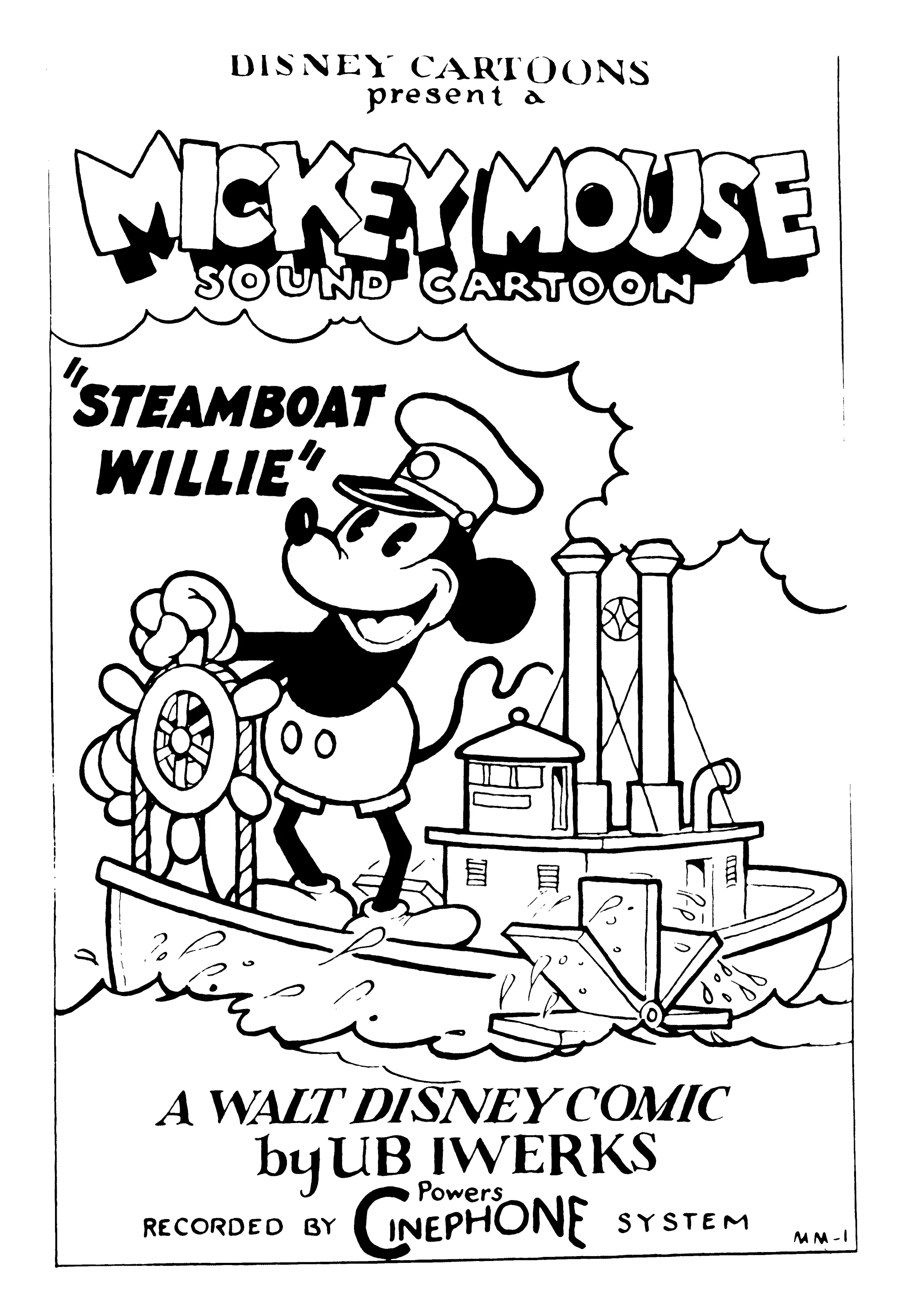
By Walt Disney / Ub Iwerks - Original Poster: https://kith.com/blogs/kith/kith-x-disney-journal, Public Domain, https://commons.wikimedia.org/w/index.php?curid=143288558
Kira Granito, Associate Editor | 2025
Disclaimer: This research article is solely intended to be an opinion piece published by students that is corroborated by facts and credible sources. Under no circumstances should any article published by the UNLV Undergraduate Law Review be considered as actual legal advice or legal counsel.
Once Upon a Copyright
Once upon a time, a mouse was born. Not in a forest or a fairytale, but aboard a steamboat - whistling his way into history. In 1928, Mickey Mouse was just a cartoon: two dots for eyes, a high-pitched laugh, and oddly lovable charm. He wasn’t yet a corporate mascot, legal case study, or a billion-dollar brand. But he would become all three.
Nearly a century later, that same cheerful mouse stands at the center of one of the most revealing sagas in American intellectual property law. Mickey’s story is no longer just about animation. It’s about ownership, access, and how legal frameworks can be reshaped to preserve monopolized power.
The Constitution grants Congress the authority to secure “exclusive Right” to authors for “limited Times”. [1] The deal was simple: temporary control in exchange for long-term cultural benefit. But as Mickey inched closer to the public domain, the terms of that bargain began to shift. Copyright durations grew longer. New forms of protection emerged. And eventually, a system built to encourage creativity became a strategy for indefinite control.
Under the current law, Steamboat Willie (Mickey’s 1928 debut) should have entered the public domain long ago. But in 1998, Congress passed the Copyright Term Extension Act (CTEA), delaying that expiration by two decades. [2] Even now, with that early cartoon technically free, Mickey remains far from accessible. Trademark, derivative works, and legal ambiguity keep Mickey trapped in Disney’s corporate castle.
What began as a cartoon has become a case study in how intellectual property law can be stretched, blurred, and repurposed to protect company assets. The boundary between copyright and trademark has eroded. The meaning of “limited Times” has expanded. And the public domain - the cultural commons promised in the Constitution - has been quietly enclosed.
Mickey’s story may have started with a whistle and a wink. But nearly a century later, his legal afterlife poses sharper questions: How did we get here? What happens when access is indefinitely deferred? And what does it mean when a mouse becomes a monopoly?
How We Got Here: A Brief History of Copyright and Disney
Before Mickey Mouse needed protecting, copyright law looked very different. The Copyright Act of 1790 offered 14 years of exclusive rights, renewable once if the author was still alive. [2] At most, a work could be protected for 28 years before entering the public domain, creating a shared resource that would benefit future creators. The law wasn’t designed to lock creative works away, but to encourage their growth.
Over the next two centuries, that balance began to shift. The 1909 Copyright Act doubled the maximum term to 56 years. [3] By 1976, amid the rise of mass media and the consolidation of creative industries, Congress passed a sweeping overhaul. The Copyright Act of 1976 changed the framework entirely: for individual authors, protection now lasted for the life of the author plus 50 years; for corporate “works made for hire,” it extended to 75 years from publication or 100 years from creation. [5] This marked a pivotal transformation - copyright was no longer a tool to incentivize creation. It became an instrument for long-term commercial control.
By the late 1990s, that shift came into full focus. Under the 1976 Act, Mickey Mouse’s 1928 debut in Steamboat Willie was scheduled to enter the public domain in 2003. [6] But by then, Mickey wasn’t just a character - he was Disney’s flagship asset. With a brand estimated in the billions, Disney lobbied Congress to extend copyright terms further, arguing that expiration would harm U.S. media industries and undermine incentives to invest in creative works. [11] Congress listened. In 1998, it passed the Copyright Term Extension Act (CTEA), also known as the Sonny Bono Act. The CTEA added 20 years to existing copyright terms, extending corporate protection to 95 years after publication. [5] Supporters claimed it harmonized U.S. law with the European Union and protected America’s cultural exports. Critics, however, saw something else: a narrowly tailored law with sweeping consequences. [10] Its effect (and arguably its intent) was to keep Mickey Mouse out of the public domain.
Legal scholar Lawrence Lessig famously called the CTEA a “poster child for rent-seeking” where powerful corporations shape laws for private benefit. [7] Jessica Litman described it as evidence that Congress had abandoned the original copyright bargain. [11] The public, promised eventual access, now had to wait another generation.
That frustration came to a head in Eldred v. Ashcroft, 537 U.S. 186 (2003), where plaintiffs argued the CTEA violated the “limited Times” clause of the Copyright Clause and suppressed speech by keeping works under exclusive control long after their relevance. [7] In a 7-2 decision, the Supreme Court upheld the law. Justice Ginsburg, writing for the majority, emphasized Congress’s broad discretion and noted that the extension was still finite. [7] But Justice Breyer’s dissent warned that the statute pushed copyright “dangerously close to perpetual,” offering little benefit to creativity and imposing significant cost on the public. [7]
That same year, the Court addressed a related issue in Dastar Corp. v. Twentieth Century Fox, 539 U.S. 23 (2003), where it ruled that companies could not use trademark law to effectively reassert control over public domain works. [8] On paper, this preserved the boundary between copyright and trademark. In practice, the ruling left an opening: as long as a company could show consumer confusion, it could still enforce trademark protections - even over characters whose copyright had expired.
Disney understood the implications. Copyright terms might end, but trademark law offered a path forward. What began as a constitutional incentive evolved into a layered system of control. Through lobbying, litigation, and strategic adaptation, Disney ensured that Mickey Mouse would remain in its grasp, not just as a creative work, but as a commercial symbol with legal protections far beyond their original scope.
Beyond Copyright: How Trademark Took Over Where Copyright Left Off
On January 1, 2024, Steamboat Willie, the 1928 cartoon that marked Mickey Mouse’s debut, entered the public domain. [18] Legally, this should have marked a cultural milestone: one of the most iconic works of the 20th century was now free for public use. But in practice, access remained limited. That’s because the expiration of copyright didn’t end Disney’s control. It simply shifted the battle to a different legal arena: trademark.
Unlike copyright, which is limited by statute, trademark protection under the Lanham Act can last indefinitely, so long as the mark remains in use and continues to identify the source of goods or services. [5] The rationale behind trademark law is fundamentally different - it serves to prevent consumer confusion, not to reward creativity. But over time, trademark became a tool to extend the commercial lifespan of copyrighted works well beyond their intended limits.
In Disney’s case, the company holds extensive trademark registrations on the name “Mickey Mouse,” as well as various visual depictions, including modern and stylized versions of the character. [6] These trademarks span everything from clothing to theme parks to entertainment services. While the 1928 Steamboat Willie cartoon may now be in the public domain, most commercial uses of Mickey Mouse remain legally risky. If a use is deemed likely to cause confusion, suggest sponsorship, or tarnish the brand, Disney can sue, even if the underlying work is no longer copyrighted.
This dynamic, known as a “dual protection regime,” creates a layered system of rights that functionally replicate the exclusivity of copyright. [14] Legal scholars like Rebecca Tushnet have warned that even when copyright expires, trademark law can create a “shadow term” that continues to deter lawful reuse. [8] Courts have allowed this so long as the enforcement focuses on commercial misrepresentation rather than expressive use. [19] But in practice, the line between parody and infringement, commentary and confusion, is often unclear - and the ambiguity works in favor of rights-holders.
Supporters of strong trademark enforcement argue that it protects consumers and preserves the integrity of beloved cultural brands. They claim that allowing widespread commercial use of iconic characters would lead to fraud, dilution, and marketplace chaos. [17] But critics argue that this justification has been stretched far beyond its original intent. This ambiguity gives companies like Disney room to operate - and room to intimidate. [17] What was meant to safeguard economic clarity has become a mechanism for cultural control.
The Supreme Court attempted to draw boundaries in Dastar v. Twentieth Century Fox (2003), holding that trademark law cannot be used to assert ownership over works in the public domain. However, the Court left room for companies to act when public uses cause a “likelihood of confusion,” meaning consumers are likely to be misled about the source, sponsorship, or affiliation of a product or service. This standard has proven slippery in practice, and the gray area is now the frontline of IP enforcement.
Disney has leaned into this ambiguity. In its 2023 press release acknowledging Steamboat Willie’s public domain status, the company emphasized that “modern versions of Mickey Mouse are not included.” The subtext was clear: the law may have changed, but enforcement would continue. The legal message was less about copyright and more about deterrence. No lawsuit is necessary when ambiguity does the work.
This strategy has proven effective. In early 2024, a horror game titled Infestation 88 featured a monstrous figure modeled after the Steamboat Willie version of Mickey. The developers issued disclaimers and avoided using the name “Mickey Mouse,” but the message was unmistakable. Disney issued no lawsuit, but the fear of one was palpable. Artists and entrepreneurs now navigate a landscape in which legal risk is omnipresent - not because of actual violations, but because of the costs of defending against even speculative claims.
Disney is not alone in that approach. Warner Bros. actively defends trademarks on Looney Tunes characters. Universal protects early versions of Frankenstein. But Disney set the playbook. Its use of overlapping rights has transformed UP enforcement into a long game of attrition where ownership may technically expire, but control persists.
In effect, the public domain becomes less about what the law allows and more about what users are willing to risk. This deterrent model doesn’t require a change in doctrine. It just requires silence and uncertainty. And perhaps that's the point.
The Shrinking Commons: Mickey, the Public Domain, and the Future of Cultural Ownership
When Steamboat Willie finally entered the public domain in 2024, the moment was heralded as historic, but in substance, it felt hollow. For advocates of creative freedom and open culture, it was less a triumph than a technicality. What should have marked a new chapter in public access instead revealed how fragile the public domain has become.
The legal mechanisms are clear: copyright terms expire, but trademark protections endure. Yet the deeper issue is not legal formality - it's cultural consequence. The public domain, once a space for reinvention and shared inheritance, is now shaped by legal ambiguity and corporate strategy. It remains theoretically available but practically out of reach.
Disney’s posture is instructive. While the company publicly acknowledged Steamboat Willie’s release, it simultaneously asserted its right over modern versions of Mickey Mouse and implied continued vigilance. That ambiguity alone is often enough to discourage use. As legal scholar James Boyle noted, “The public domain is increasingly defined not by what the law permits, but by what users are willing to risk.” [15]
This chilling effect does not require active enforcement. It thrives on uncertainty. Independent creators, scholars, and developers must weigh the cost of potential litigation against the value of using culturally significant material. The result is a privatized commons - governed not by ownership, but by fear.
There are emerging calls to address this imbalance. Scholars like Jessica Litman and Lawrence Lessig argue that the public domain should be treated as a positive legal entitlement, not merely the absence of rights. James Boyle proposes that public domain protections deserve statutory reinforcement, particularly where overlapping IP regimes threaten to nullify access. [16] These are not radical proposals. They return to the constitutional premise: that copyright is a temporary incentive, justified only by its ultimate benefit to the public.
Defenders of the current system argue that creators and companies deserve to protect their investments for as long as the market demands. They claim that weakening these protections would undercut innovation, damage brand value, and create confusion, but this argument conflates economic interest with cultural stewardship. The public domain is not a loophole; it is a legal institution with constitutional roots. When it becomes functionally unusable, the underlying bargain collapses.
Mickey Mouse is no longer just a symbol of nostalgia or corporate identity. He is now a legal artifact - a representation of how intellectual property law can evolve to privilege indefinite control over eventual access. And while the CTEA may be the most visible example of legislative capture, it is the interplay of copyright, trademark, and the chilling effect that does the real work of enclosure.
Other companies have followed suit. Warner Bros. enforces trademark protections on Superman and Looney Tunes characters, even as early works approach or enter the public domain. Universal protects the likeness of Frankenstein’s monster, despite the character’s literary origin having long expired. What unites these efforts is not legal clarity, but legal leverage.
Whether through legislative extension or doctrinal overlap, the result is the same: a narrowing cultural commons. Creators face not just closed doors, but invisible walls. The question is no longer whether the public domain exists because it does - on paper. The question is whether it can be meaningfully used without risking litigation or confusion.
The erosion of that usability carries real consequences. Works that could inspire parody, adaptation, education, or commentary remain untouched. The cost is not only artistic freedom but also democratic discourse. Copyright law was designed to promote progress. When it becomes a vehicle for stagnation, the public loses more than a mouse. It loses a future of shared stories.
A Mouse-Sized Mirror
The tale of Mickey Mouse is no longer just a cultural anecdote - it’s a mirror reflecting the evolving priorities of American Intellectual property law. What began as a limited-time monopoly to encourage creativity has become a layered regime of overlapping protections designed to preserve corporate control.
Copyright was meant to serve the public good. It was built on a constitutional promise: that exclusive rights would be temporary, and that the public would inherit the fruits of creative labor. But today, a cartoon mouse tells a different story. One of term extensions, trademark fallback strategies, and a legal landscape shaped less by constitutional principle than by commercial interest.
Mickey’s enduring legal protection is not an outlier. It is a prototype. The systems that keep him fenced off are replicable, scalable, and already in wide use. The problem is not just that a single character remains out of reach, but that the legal frameworks designed to ensure public access have been steadily retooled to delay or deny it.
That shift carries broader implications. The erosion of the public domain is not only a loss for artists and educators - it’s a loss for democratic culture. When cultural icons become indefinitely controlled assets, the ability to critique, remix, or reimagine them narrows. And the public, promised a return on its bargain, is left waiting.
Mickey Mouse still smiles. He still sells. But behind that smile lies a century of legal evolution that reveals more about the state of intellectual property than any statute or casebook. The central question is no longer what we can do with Mickey Mouse. It’s what we’ve lost waiting for him.
Sources
U.S. Const. art. I, § 8, cl. 8.
Copyright Act of 1790, ch. 15, § 1, 1 Stat. 124.
Copyright Act of 1909, ch. 320, § 23, 35 Stat. 1075.
Copyright Act of 1976, Pub. L. No. 94–553, 90 Stat. 2541 (codified as amended at 17 U.S.C. §§ 101–810).
Copyright Term Extension Act of 1998, Pub. L. No. 105-298, 112 Stat. 2827 (codified in scattered sections of 17 U.S.C.).
Lanham Act § 45, 15 U.S.C. § 1127.
Eldred v. Ashcroft, 537 U.S. 186 (2003).
Dastar Corp. v. Twentieth Century Fox Film Corp., 539 U.S. 23 (2003).
Sunbeam Prods., Inc. v. West Bend Co., 123 F.3d 246 (5th Cir. 1997).
Lawrence Lessig, Free Culture (2004).
Jessica Litman, The Public Domain, 39 Emory L.J. 965 (1990).
William Patry, The Failure of the American Copyright System: Protecting the Idle Rich, 72 Notre Dame L. Rev. 907 (1997).
Derek Slater, The Mouse That Ate the Public Domain, 1 Harv. J.L. & Tech. 69 (2002).
Mark A. Lemley, Intellectual Property and Shrinking the Commons, 57 Fla. L. Rev. 135 (2005).
Pamela Samuelson, Mapping the Digital Public Domain: Threats and Opportunities, 66 Law & Contemp. Probs. 147 (2003).
Siva Vaidhyanathan, Copyrights and Copywrongs: The Rise of Intellectual Property and How It Threatens Creativity (2001).
Jennifer Jenkins, The Superman (Still) Isn’t Yours, Duke Ctr. for the Study of the Pub. Domain (2021).
“Steamboat Willie Enters Public Domain,” U.S. Copyright Office (Jan. 2024), https://www.copyright.gov.
“Disney Public Statement on Mickey Mouse IP Rights,” The Walt Disney Company (Jan. 2024), https://thewaltdisneycompany.com